The Smithfield Lake is back!
After a few weeks of little to no rain, the kind that left Uisce Éireann talking about stretching the hosepipe ban past the original 26 August deadline, last night the sky finally remembered how rain works. It remembered a little too well. Torrential downpours flooded parts of Kerry and Dublin; Phoenix Park apparently took more water in two hours than it had in the previous two months, which is the sort of statistic that only makes sense in an Irish summer.
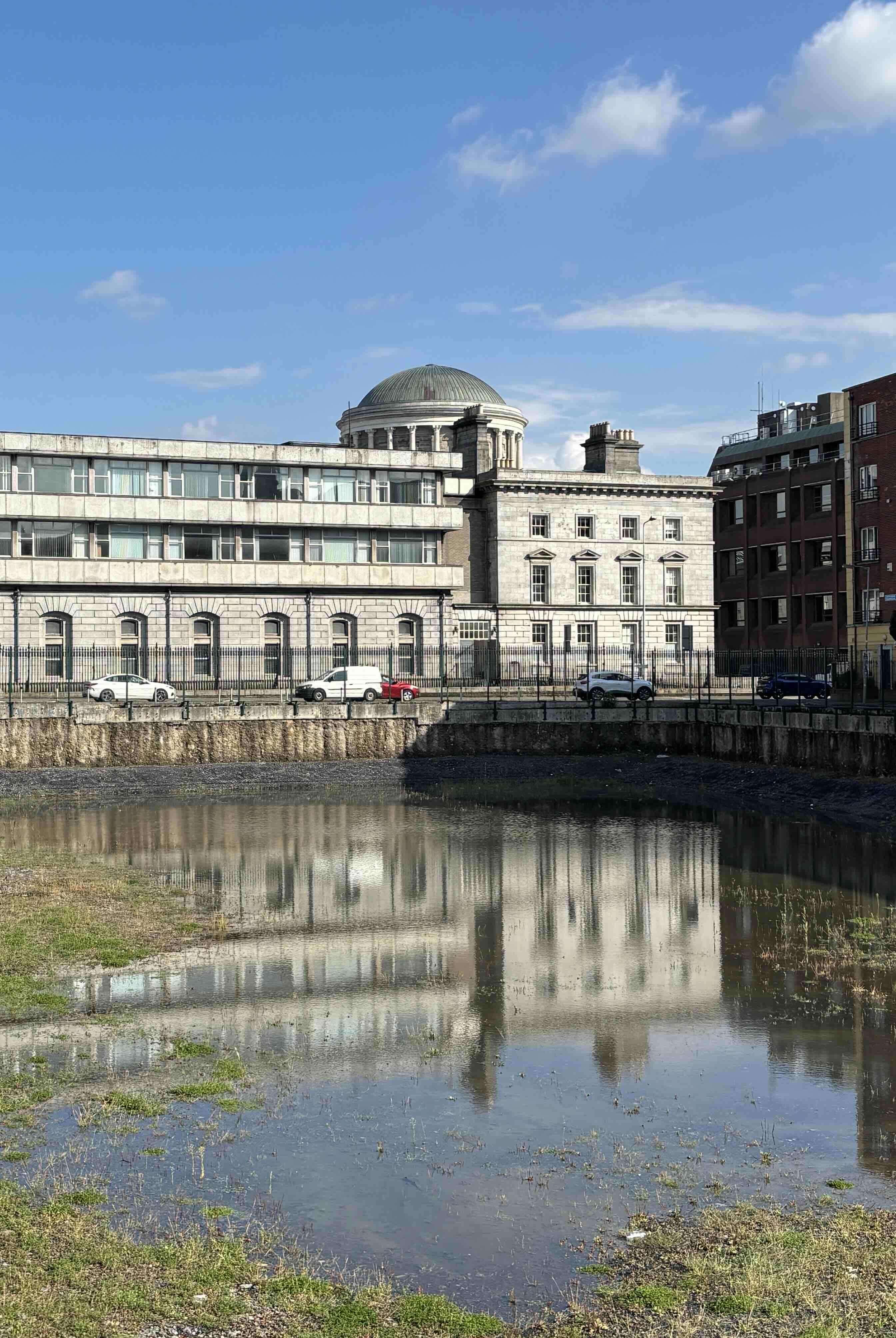
One of the more photogenic side effects, at least if your idea of photogenic includes a muddy hole with a Four Courts reflection, was the return of the beloved Smithfield Lake. That is the unofficial name for the flooded plot beside the Red Luas line, celebrated on Reddit as Ireland’s prettiest lake, and I am almost certain that at some point last year you could type “Smithfield Lake” into Google Maps and find a perfectly serious pin waiting for you.
I am not against a proper park with a small lake. This is not that. This is a vacant building site that fills with water whenever the weather decides to make a point, then sits there looking almost handsome until someone remembers it was supposed to be a courthouse.
Since I started walking past this corner regularly I have watched it cycle through a series of identities, none of them lasting long enough to become a neighbourhood. First it was presented as a site of Viking ruins: during early evaluations around 2010, archaeologists found remains of an 11th-century Hiberno-Norse house under the old factory ground. Then those ruins were covered over. Then the plot became a compound for the crews building the nearby blocks at Carman Hall and Haymarket, which now hold offices for the National Transport Authority, Tailte Éireann’s Valuation Office, and the Chief State Solicitor’s Office, along with a Tesco Express and the excellent Proper Order Coffee. Once that work finished, the site was left empty again. That is when the lake appeared, and apart from some work to reinforce the walls, almost nothing else has happened.
A bit of digging turned up the older story. The plot used to be the Hammond Lane match factory, better known as Maguire & Paterson, a wedge of land between Hammond Lane, Church Street, and Bow Street, right against the Luas tracks. After a string of mergers around 1919 it became the Dublin heart of Irish match-making, and it kept striking until the factory closed in 1989. Maguire & Paterson even put the Four Courts on the matchboxes, which gives the current view a kind of accidental poetry: the dome is still there, only now it is floating in a puddle. Before the matches, Hammond Lane had already had a violent industrial life. In 1878 a boiler exploded at a foundry on the street, killing fourteen people, still one of the worst industrial accidents in the city.
The Office of Public Works bought the derelict site in 1998. By 2012 it had been earmarked for a new Dublin Family Court complex: six storeys, nineteen courtrooms, mediation rooms, the whole thing meant to pull family law out of the scattered rooms at Dolphin House, Chancery Street, Phoenix House, and the Four Courts. Plans were finally published in 2023. More recent reports say construction should start in early 2027. This is Dublin, though, so I will believe it when I see a crane that is not just visiting. At this rate MetroLink will arrive first, and that is another project I have been hearing about since I moved here: a long parade of promises, delays, plans, complaints, and court-suggested mediation.
This is not the only vacant hole in Dublin, or in Ireland. Generational messes do not tidy themselves overnight, especially when every attempt at change is met with a round of criticism and a trip to the courts. That said, I do love this city, a lot, and it still gets to me when I see how it is allowed to sit. This plot is only one example among many; Derelict Ireland and pieces like this one keep a running inventory. I have a suspicion that the people least interested in improving Dublin are sometimes the people living in it. That, however, is a story for another time.
— Made withCursor