Partially Total Solar Eclipse
No, it was not a total eclipse of the heart. Bonnie Tyler can keep that one. What we got in Dublin was still a very emotional affair, even if the Moon politely declined to finish the job.
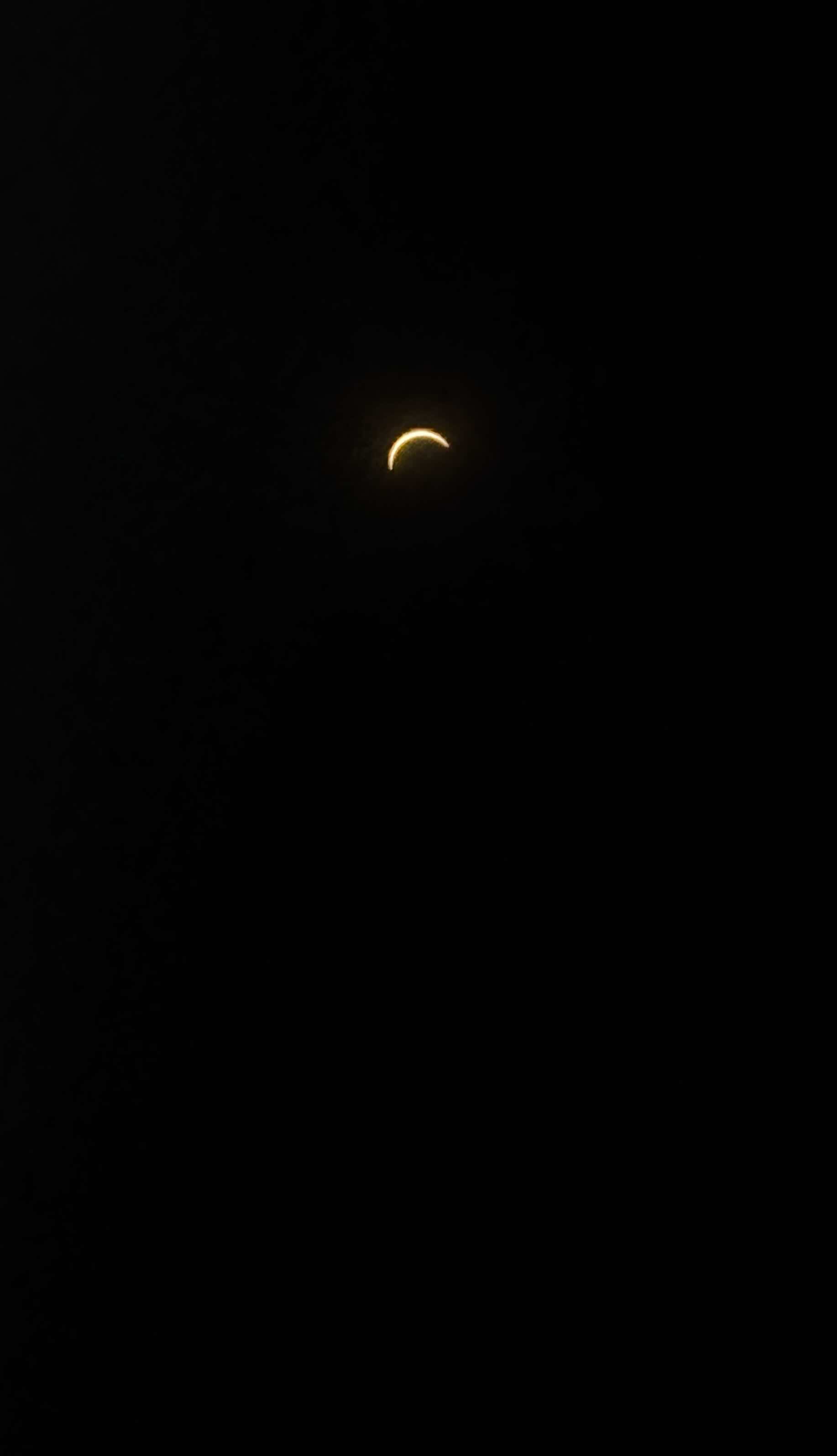
Space has always fascinated me, especially the stars and our Moon, which may or may not explain why, as a child, I was madly in love with anime like Saint Seiya and Sailor Moon. Armour, constellations, a sailor guardian of the Moon: of course I was going to grow up into the sort of person who buys eclipse glasses at the last minute.
When the news started circulating that a deep partial solar eclipse would be visible from Dublin, covering about 94 percent of the Sun, I finally started making preparations. For someone who claims to love space, I should probably have begun planning earlier. I bought a surprisingly cheap set of proper glasses and a couple of those little screens you clip over a phone to take pictures without frying the camera, then spent an unreasonably long time working out which way up they go. Suffice to say the learning curve was steeper than the packaging suggested, but I managed a few shots I am actually happy with.
On the day, Dublin was absurdly lucky: a clear sky and a warm evening, which is not the sentence I usually write about Irish weather. Perfect for eclipse watching, especially compared with a few friends who went all the way to the south of Spain and were greeted by cloud. I will try not to sound too pleased about that.
The most recent solar eclipse I remember was the partial one on 11 August 1999, watched from Italy (thank you, Wikipedia, for reminding me of the date). We looked through welder’s glasses that a friend’s father had managed to produce, which felt very official at the time. There was also the suggestion that a few layers of film would do the trick; I do not think that was a great idea for anyone’s eyes. What stayed with me was everything else: the way the afternoon dimmed into a kind of twilight, the street lights clicking on in the middle of the day, and the crickets and cicadas going quiet for a few minutes before they decided the world had not, in fact, ended, and started chirping again. That memory sat with me for 27 years. This year I got to have a version of it again.
Both ESA and NASA ran live streams, and both put out photographs that make my phone-and-clip-on-screen efforts look like a polite sketch. ESA has a look back from the path of totality; NASA has Bill Ingalls’ composite over a field of sunflowers in Spain. I watched from Dublin and tried not to be greedy.
While talking with friends during the day I realised I was not entirely sure how the new-moon requirement for a solar eclipse actually works, or even what a new moon is. There was a brief, confident debate about whether the Moon was on the other side of the Earth, which is a very reasonable guess until you draw the three bodies on a napkin and notice it cannot possibly be true. A solar eclipse happens only when the Moon moves directly between the Earth and the Sun. That alignment turns the unlit face of the Moon toward us, which is exactly what a new moon is: the first lunar phase, when the side we see is dark. The Moon is not hiding behind the planet. It is standing in front of the light.
The other thing that struck me, once I started reading, is how ordinary eclipses are in the universe and how strange ours still are. Whenever a moon passes in front of its star or its planet, you get an eclipse; Jupiter, with its crowd of moons, has them all the time, and binary stars eclipse one another constantly. What Earth gets, for now, is the theatrical version, the one that can hide the Sun so neatly that the corona appears. Our Sun is about 400 times wider than the Moon, and also about 400 times farther away, so they look almost the same size in the sky. Most moons in the solar system are too small, or too far, or they cover too much. We are in a window where the match is almost perfect, which is a ridiculous piece of luck to live inside and then treat as a Tuesday.
The next total solar eclipse visible from Europe is on 2 August 2027, from southern Spain. On 26 January 2028, Portugal and Spain get an annular eclipse, a ring of fire, with a partial view across the rest of Europe. I still have to sit with the difference: in a total eclipse the Moon is close enough, or large enough in the sky, to cover the Sun completely; in an annular one it is a little too far away, so a bright ring remains. I will probably need another napkin.
Of course all this Moon talk sent me back to songs. Here are a few I love, in no particular order except the one that opened this post.
- The Italian opening for SuperS, the season where the Dead Moon Circus arrives with an eclipse.
- I first met this song as the Evangelion ending, which is a pile of covers. The recording I keep going back to is Sinatra with Count Basie.
I hope one day to stand in the path of totality. Never say never.
— Made withCursor